Music Teachers - Tabla
About Tabla lessons
Tabla
The tabla is one of the most popular instruments in use in India, and the Indian Subcontinent. The numerous sounds and richness the instrument offers, makes it compatible in a wide range of music styles, such as Hindustani Classical, Bollywood, Folk and later even Pop and Jazz. Having said that, the tabla has been explored in great detail in the North Indian Classical music tradition, with masters from the past 500 years contributing to its compositional repertoire, rich sound production and playing techniques.
Tradition
Tabla playing in North Indian Classical music has evolved as a strong tradition in the past 500 years in India. In this evolution, the tradition has seen it self branch out into 6 main schools of tabla playing. In the North Indian Classical Arts, these schools are known as Gharanas. North Indian Classical arts have different gharanas for Voice, Dance, Instrumental Playing ( Sitar, Bansuri etc.) and also tabla. The 6 schools of tabla playing are - Delhi, Farrukhabad, Punjab, Lucknow, Benaras and Ajrada.
Picking up the Tabla
- Learning to play Hindustani Classical Music on the tabla.
- Learning the techniques, sound production and the solo repertoire of the tabla.
- Learning Indian Rhythms, to improve your sense of rhythm and rhythmic creativity.
- Diving into the spiritual and philosophical side of music
Is Tabla popular?
The tabla is one of the most popular instruments in India and has a tradition spanning over 500 years in North Indian classical music. Complex rhythms and structures are typical of tabla music, and it requires years of study to achieve the virtuosity characteristic of good tabla players.
Versatile instrument
Tabla players create a wide range of sounds, from clear ticking tones to basses that seem to come from underwater. Tabla music is known for its sophisticated rhythmic structures and challenging rhythms, which requires dedication and high concentration from the musician. In addition to accompanying vocals, bansuri, Hindustani harmonium, and violin, the tabla is often played solo in virtuosic, immersive pieces.
How do you play tabla?
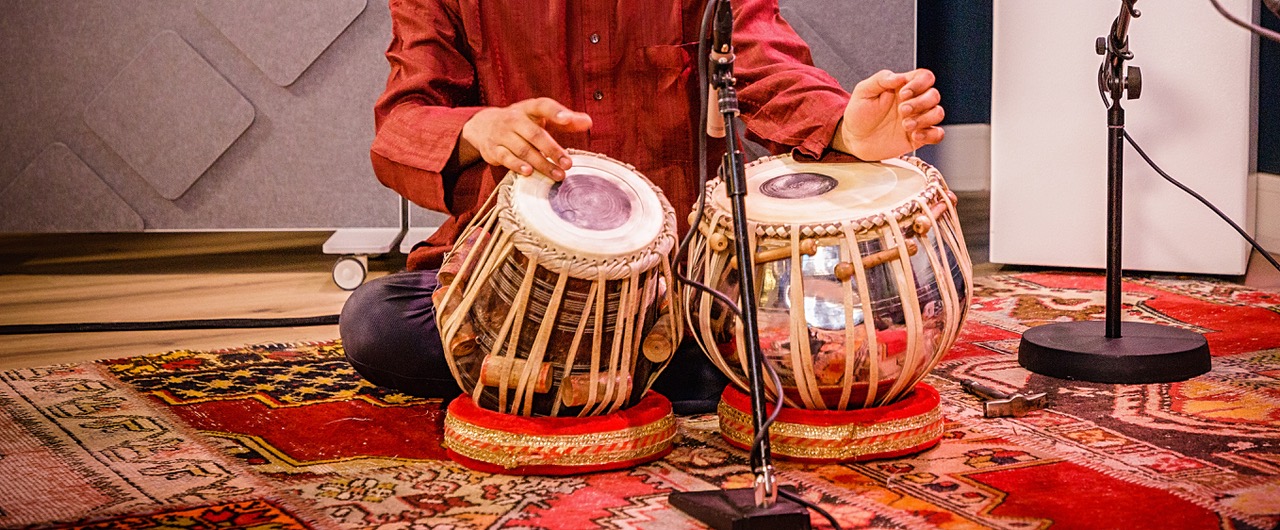
Unlike many well-known drums, you play the tabla with all your fingers. You do this one by one, just like on a piano. This allows you to play incredibly fast and detailed patterns. With the palm of your hand, you can vary the pressure on the left drum (Bayan), allowing you to change the pitch while playing and creating a kind of upward or downward glissando.
Richness of rhythm and sound
The enormous richness of different sounds and the dynamic possibilities ensure that this beautiful percussion instrument also comes fully into its own in various diverse musical genres. In addition to classical Hindustani music and Bollywood, the tabla is also used in a spectacular way in Crossover, Folk, Pop, and Jazz!
Tabla for everyone
Both Western and non-Western musicians from diverse cultures are fascinated by learning to play the tabla and mastering its typical rhythms and virtuoso playing technique. Naturally, we start from classical Hindustani music and the specific technique for playing the tabla. The tabla is used both as a solo instrument and to accompany singers and instrumentalists.
Spiritual and philosophy
Delving deeper into culture and philosophical/spiritual backgrounds can be an essential part of the tabla lessons.
Tradition
Playing the tabla is a highly virtuosic art form in North Indian Classical music. There are six main schools of tabla playing. These schools are called Gharanas. In North India, there are also different Gharanas for vocal music, dance, and instrumental music (Sitar, Bansuri, Tabla). The six tabla schools are those of Delhi, Farrukhabad, Punjab, Lucknow, Benaras, and Ajrada.