

Music Teachers - Qanun
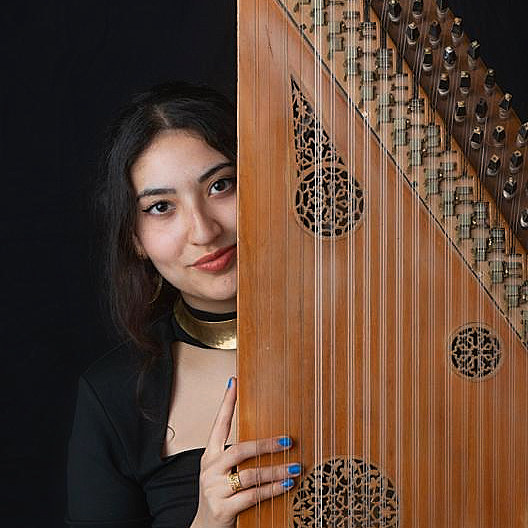
About Qanun lessons
Where does the qanun come from?
The qanun is a majestic, deeply expressive Middle Eastern string instrument. Its history goes back to ancient times, and it belongs to the zither family. Over the centuries, it spread across the Middle East and became a key instrument in many musical traditions. According to legend, the qanun was inspired by the sound of wind blowing through the dried intestines of a dead bird hanging from a tree. There are different versions of this story, but it gives you an idea of how poetic the origins of the instrument are.
What does the qanun mean to you?
For many people, the sound of the qanun instantly feels like home. It brings back moments like morning coffee brewing, with Fairuz singing in the background and the band answering her melodies.
Structure in the music
The qanun plays a central, connecting role in an ensemble or orchestra. By playing clear rhythmic and melodic patterns, the qanun player gives structure and timing to the group. In Arabic, the word “qanun” literally means “law” or “rule”—which is exactly how the instrument functions within an ensemble
How do you play the qanun?
You play the instrument with both hands, usually using plectrums attached to your fingers. This allows you to create smooth, flowing, highly ornamented melodies. In Middle Eastern and Turkish music, the qanun is deeply rooted in the maqam system, a framework of scales and melodic development that combines composition with improvisation
Do you use a plectrum?
Yes you do, but not like on a guitar. You wear small rings on your fingers with attached picks (called mezrab). That’s what you use to pluck the strings.
How many strings does a qanun have?
A qanun typically has 72 or 78 strings. These are grouped into sets of three strings (called “courses”), meaning there are 24 to 26 groups in total. Each group is tuned to the same note, so the three strings sound as one. A standard professional Turkish qanun usually has 26 courses, so 78 strings in total. The strings are made from nylon or PVC and are tuned using a special tuning key.
What are mandals?
The instrument has small levers called 'mandals', which are used to adjust the pitch of the strings in microtones. The qanun may look a bit like a cimbalom or a zither, but it’s played very differently.
What’s the effect of microtones?
These mandals let you raise or lower the pitch in very small intervals, smaller than the notes you hear in Western music. This opens a huge range of tonal possibilities. By quickly switching mandals, you can subtly change a note or move into a completely different musical mode. This is what gives the music its authentic sound, expression, and emotional depth.
Is the qanun like a piano?
Not really, but there are some similarities. The qanun has a range of three octaves. Like the piano, it has a wide range compared to most instruments. However, traditionally, these octaves are not used to play melody and accompaniment at the same time. The focus is usually on a single melodic line, rich with ornamentation.
Can you play chords on the qanun?
Yes, you can. It’s possible to play melody with one hand and chords with the other. It’s not the most traditional approach, but it’s definitely possible, and it opens up new creative directions.